
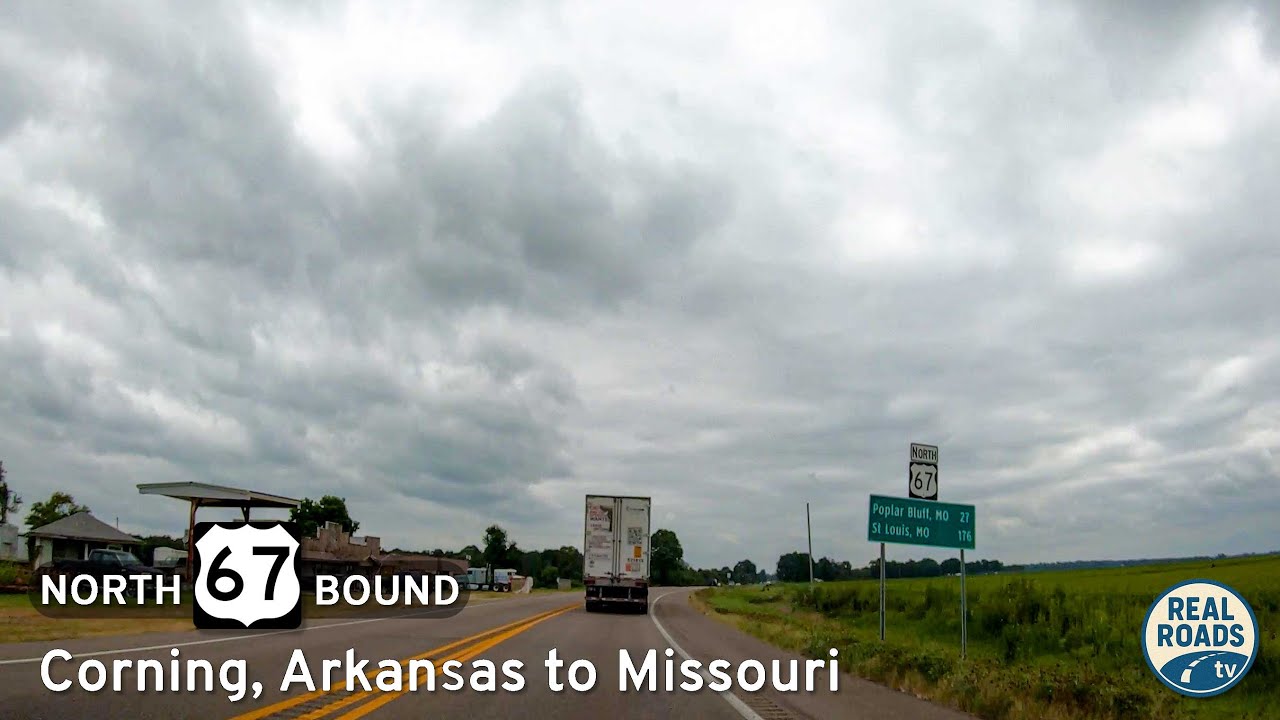
Take a quiet northbound drive through the far northeastern edge of Arkansas as we follow U.S. Route 67 from Corning to the Missouri state line, a brief but telling stretch of highway that reflects the Delta’s agricultural rhythm and the road’s long-standing role as a regional connector. Not every road trip starts at home, and this segment feels like one of those in-between journeys—short on mileage but rich in context—where the landscape quietly signals a transition from one place to the next. Though the distance is modest, the road carries us away from a county seat and almost imperceptibly toward another state, another chapter of the same north–south corridor.
We begin in Corning, at the northern edge of town where U.S. Route 67 takes on a distinctly transitional character. The roadway is still framed by a light commercial presence—small businesses, service stations, and roadside signage that speak to Corning’s role as a practical stop along the route rather than a sprawling urban center. This stretch makes it clear that the town developed with the highway in mind, oriented toward movement and connectivity rather than separation. U.S. 67 functions here as both a local main artery and a northbound gateway, easing travelers out of town with little ceremony and setting the tone for a calm, unhurried drive ahead.

Almost immediately, the feel of the drive begins to shift. The last clusters of buildings fall away, intersections grow farther apart, and the highway straightens as it settles into its rural alignment. The landscape opens wide, revealing the flat, expansive terrain that defines this part of Clay County. Fields extend toward the horizon on either side of the road, broken by drainage ditches, tree lines, and the occasional farm access road. The sense of enclosure fades quickly, replaced by long sightlines and open sky—an unmistakable signal that we’ve left the town’s edges behind and entered the working heart of the Arkansas Delta.
Once clear of Corning, U.S. 67 becomes a straightforward ribbon through the Delta, defined less by curves or elevation changes and more by consistency and scale. Depending on the season, the fields alternate between deep green growth, freshly turned soil, or harvested stubble, each offering a different texture to the same enduring landscape. Tree lines trace property boundaries and waterways, subtly framing the roadway without interrupting the view. This is a place built around production and movement, and the highway’s design reflects that purpose—direct, efficient, and easy to follow. It’s the kind of road that lends itself naturally to slow travel, where the scenery doesn’t demand attention but rewards it all the same.
As we continue north, the rhythm of the drive remains steady. There are no major interchanges, no abrupt changes in traffic flow—just the quiet consistency of vehicles moving between Arkansas and Missouri. U.S. 67 has long carried this responsibility, linking small Delta communities to larger trade centers like Poplar Bluff farther north, and this short segment plays its role without drawing attention to itself. The road reinforces its identity as a through-route rather than a destination, offering an understated appeal rooted in open skies, straight pavement, and the subtle details of rural land use unfolding mile by mile.

Approaching the state line, signage becomes sparse and the transition nearly seamless. The Arkansas Welcome Center, set just south of the Missouri border, provides one of the few formal pauses along this stretch—a familiar waypoint for travelers on a Weekend Roadtrip or a longer northbound haul. It offers a moment to stop, stretch, and acknowledge the crossing of an invisible line. Beyond it, U.S. 67 continues into Missouri with the same quiet confidence, unchanged in character and purpose.
In the end, this short drive from Corning to Missouri captures an essential truth about many American highways: length does not determine importance. These six miles pass quickly, but they reveal how U.S. Route 67 supports agriculture, connects communities, and carries travelers onward with calm consistency. It is a modest segment, yet it fits cleanly into the broader story of a highway that has long stitched together the Delta and the Midwest—mile by mile, field by field, state line by state line.
🎵 Music: Track List
Music from this video may be available for purchase at https://theopenroadcollective.com
🗺️ Route Map
![U.S. Route 67: Walnut Ridge to Pocahontas [Revisited]](https://realroads.tv/wp-content/uploads/2025/12/rrtoxrmakrumaxresdefault-320x180.jpg)
0 Comments