
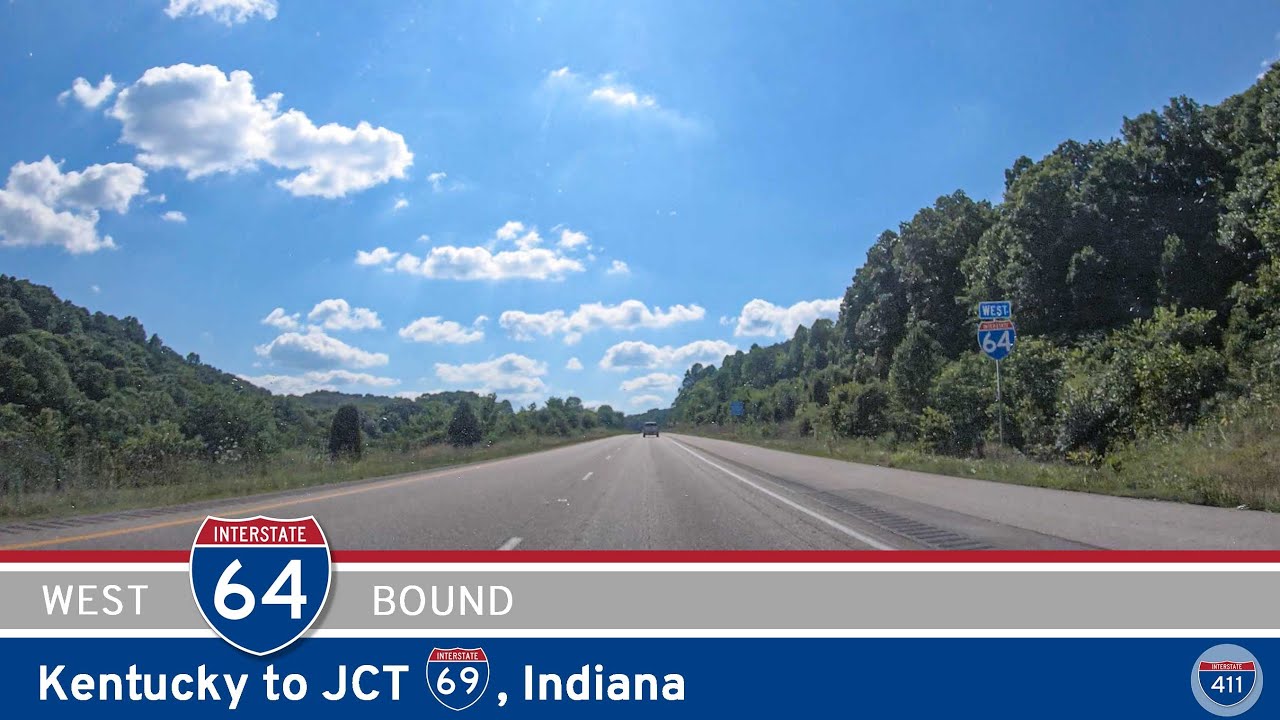
Take a measured drive across the southwestern edge of Indiana as we follow Interstate 64 eastbound from the Illinois state line to Elberfeld, a roughly 29-mile segment that quietly marks the shift from open Midwestern plains into the more wooded, inward-looking landscapes of southern Indiana. While this stretch of interstate doesn’t announce itself with skylines or dramatic landmarks, it plays an essential role in knitting together regions—and it does so with a calm, almost understated rhythm that feels distinctly different from what we leave behind to the west.
We begin at the Illinois–Indiana state line, where the crossing itself is subtle but meaningful. Almost immediately, the surroundings begin to change. The wide-open agricultural vistas common in Illinois give way to tighter tree lines and denser vegetation. The highway gently settles into the rolling lowlands of Indiana, and the road feels more enclosed as wooded buffers move closer to the shoulders. Even the soundscape changes slightly, with the interstate threading through forested corridors rather than cutting across exposed farmland. It’s a transition that drivers may feel more than consciously notice, but it sets the tone for the miles ahead.
As we continue eastward, the landscape alternates between patches of forest and stretches of working farmland. Fields open briefly before giving way again to trees, creating a steady visual rhythm that feels balanced and unhurried. The terrain remains mostly flat with light rolling contours, but the presence of woods breaks up long sightlines and adds a sense of depth to the drive. Unlike interstates designed to dominate their surroundings, this portion of I-64 feels integrated into the land, following its contours rather than imposing on them.
Traffic along this stretch is typically moderate and predictable. Long-haul trucks share the roadway with regional commuters and cross-country travelers, but congestion is rare outside of occasional seasonal surges. The spacing between exits reinforces the rural character of the route—interchanges are functional rather than frequent, serving local roads and small communities rather than dense commercial zones. Overpasses appear periodically, often framed by trees, and signage remains minimal, keeping the focus on forward motion rather than visual clutter.
Moving deeper into Indiana, the influence of southern Indiana’s mixed land use becomes more apparent. Wooded areas grow thicker in places, especially along low-lying sections where creeks and drainage corridors run parallel to the roadway. In other spots, farmland opens up again, with barns, grain bins, and fence lines visible just beyond the tree line. Seasonal changes dramatically alter the character of this drive: summer brings lush green canopies, fall fills the corridor with muted reds and golds, and winter strips the trees bare, revealing the gentle contours of the land beneath.
As we approach Warrick County, the interstate maintains its steady, no-nonsense design. This is a working highway—built for reliability and continuity rather than spectacle. Yet there’s a quiet scenic quality here, especially in how the road moves through the landscape without interruption. It’s a stretch where the act of driving itself becomes the experience, marked by consistent pavement, gradual curves, and a sense of continuity that encourages relaxed, attentive travel.
The segment concludes near Elberfeld, where Interstate 64 meets Interstate 69. This junction represents a significant shift in regional mobility. Interstate 69 now serves as a major north–south spine through Indiana, redirecting traffic flows and reshaping how travelers move between the Ohio River region and central Indiana. At this interchange, eastbound I-64 traffic intersects with a corridor that connects Evansville, Bloomington, and Indianapolis, marking Elberfeld as a quiet but important crossroads in the state’s transportation network.
Taken as a whole, this drive from Illinois to Elberfeld highlights how even shorter interstate segments can reflect broader regional transitions. It’s not a route defined by landmarks or urban energy, but by subtle shifts in landscape, land use, and atmosphere. If you’re curious about what’s around you, this route has a lot to offer—a reminder that some of the most representative stretches of highway are the ones that connect places quietly, without asking for attention, yet leaving a clear sense of where you’ve been and where you’re headed.
🎵 Music: Track List
Music from this video may be available for purchase at https://theopenroadcollective.com
🗺️ Route Map

![Interstate 57: Cairo to Mt. Vernon ~ Illinois [Revisited]](https://openroadarchive.com/wp-content/uploads/2026/01/wg13hzhqi68maxresdefault-320x180.jpg)
0 Comments