

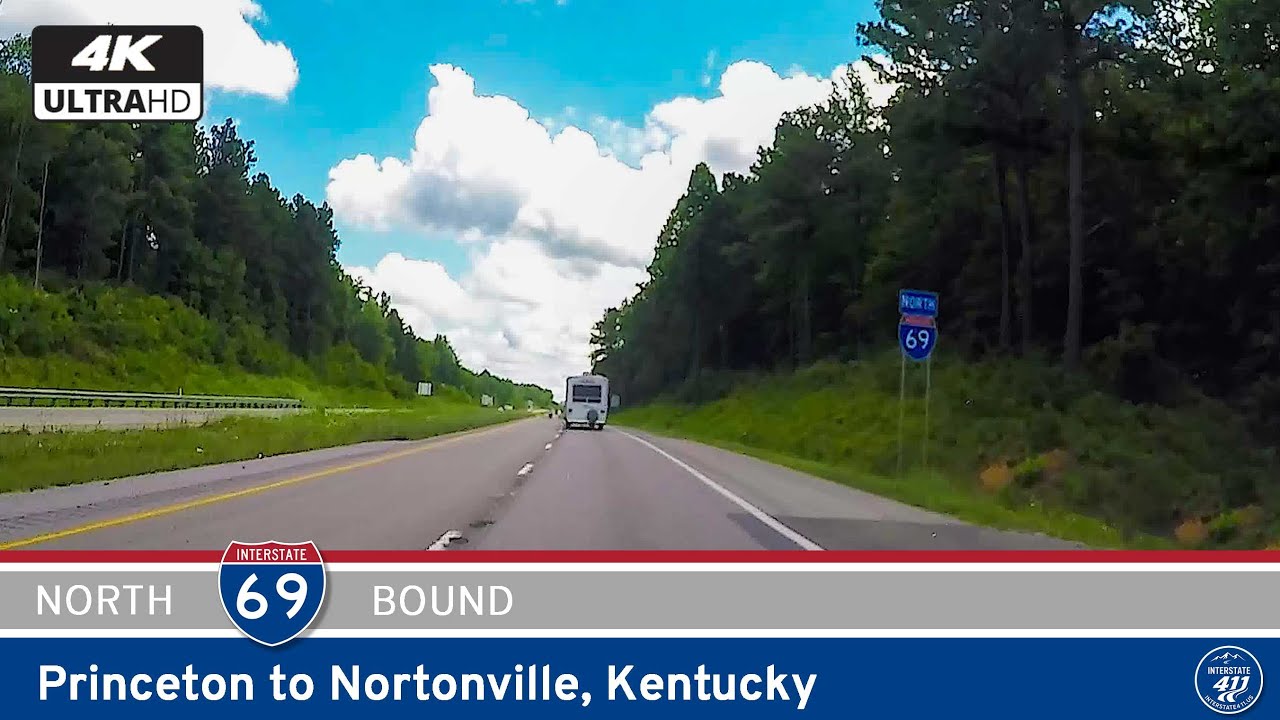
Take a drive north through the heart of southern Indiana as we follow Interstate 69 from Bloomington to Indianapolis, a 48-mile journey that carries us from wooded hills into the organized momentum of the state’s capital region. This stretch represents one of Indiana’s most significant modern highway projects — transforming the former State Road 37 corridor into a full interstate standard route and creating a direct, high-speed connection between the college town of Bloomington and the Indianapolis metro.We begin just north of Bloomington near the interchange with State Road 37, where the newly designated Interstate 69 takes over as the primary north–south spine of this part of the state. Immediately, the character of the road reflects its recent construction: wide shoulders, cleanly engineered ramps, and long, deliberate curves that follow the natural contours of the land. The first miles feel distinctly southern Indiana — wooded hills flank the corridor, and the terrain rolls gently beneath us. Bloomington itself, home to Indiana University Bloomington, quickly fades in the rearview mirror as the interstate settles into open countryside.
Moving north toward Martinsville, the landscape begins to broaden. Tree lines still appear frequently, but the forest gives way to more open farmland. Fields stretch back from the right-of-way, interrupted by drainage channels and access roads that serve local farms and smaller communities. The interchanges here are spaced at steady intervals, connecting towns that once relied on the older highway configuration. Near Martinsville, the corridor shows clear evidence of its transitional history — this was long a surface arterial before being upgraded to interstate standards. Now, overpasses replace traffic signals, frontage roads handle local traffic, and the flow remains uninterrupted as we continue north.
Beyond Martinsville, we begin to feel the gravitational pull of Indianapolis. Development becomes more frequent. Subdivisions, commercial buildings, and warehouse spaces appear alongside the highway. Traffic density gradually increases — a blend of commuters heading into the city, regional travelers connecting to other interstates, and freight traffic moving between southern Indiana and the broader Midwest. The terrain flattens slightly compared to the hills near Bloomington, and the corridor widens visually as multiple lanes accommodate growing demand.
As we approach Johnson County, signage grows more prominent and exit spacing tightens. Sound barriers begin to line portions of the roadway, signaling our arrival into the outer suburban belt. Retail centers cluster near major interchanges, and feeder roads carry traffic toward communities like Greenwood. The interstate maintains a smooth, controlled-access design, but the environment unmistakably shifts from rural to suburban. The skyline itself remains mostly hidden until the final approach, but the density of infrastructure tells the story well before we see it.
The final segment guides us toward the southern reaches of Indianapolis, where I-69 integrates into the larger metro network and prepares to intersect with the city’s beltway, Interstate 465. Here, traffic patterns grow more complex. Lane assignments matter. Overhead gantries direct drivers toward downtown, toward the airport, or toward cross-country routes that continue east and west. The feeling of openness we experienced near Bloomington is replaced by the coordinated choreography of urban interstate travel.
What makes this drive compelling is the contrast — in less than an hour, we move from wooded hills and collegiate calm into the structured pace of a major metropolitan area. It is a corridor that reflects Indiana’s economic and geographic realities: agriculture giving way to logistics, small-town rhythms transitioning into capital-city motion. Despite its modern construction, the route still preserves a sense of order and predictability, making it one of the smoother transitions from rural to urban interstate driving in the Midwest. If you feel like breaking up the trip, there’s plenty around to pick from before reaching the city.
🎵 Music: Track List
Music from this video may be available for purchase at https://theopenroadcollective.com
🗺️ Route Map

![Interstate 69: Interstate 64 to Evansville – Indiana [Revisited]](https://openroadarchive.com/wp-content/uploads/2025/09/ipbohcyijqqmaxresdefault-320x180.jpg)

0 Comments